4a. Observations of practice
Visit 1
| Date | 28/04/2026 |
|---|---|
| Who observed me | Fatima Nazar |
| VIT registration no. | 311221 |
| Signature | Fatima Nazar |
| Class observed | Year 8 Digital Technologies (Inquiry class) — Python programming |
Summary of feedback received and reflection on what I have learned
My mentor, Fatima, observed an early lesson in the Python programming unit — the introduction to programming. As we share teaching across two classes in the same open, connected classroom space, this observation also reflected our ongoing practice of supporting one another's teaching in a shared environment.
Fatima's feedback was strongly positive on student engagement. She noted that the students were highly engaged with the material, which she recognised as significant given that this was a coding class — a context where students often begin disengaged or apprehensive. She specifically affirmed the effectiveness of my lesson structure: the chunking of the work, the explicit demonstration of each concept, followed by students applying it themselves. She identified this gradual-release approach as a clear strength that was keeping students engaged and on task.
She also commented on the use of Kahoot as an engaging, effective tool that the students responded well to. A useful practical point that emerged from the observation concerned our shared, connected classroom space: interactive activities such as Kahoot can be complicated by two classes running in proximity, as separate game sessions can interfere with one another. This was a valuable reminder to plan the logistics of interactive tools carefully within our particular teaching environment.
What I learned / reflected on
This observation affirmed that my core instructional approach — explicit modelling followed by student application, punctuated with game-based engagement tools — was working as intended and was successfully engaging students in a subject they typically find intimidating. It also prompted me to be more deliberate about the practical coordination of interactive activities in a shared classroom space, so that engagement tools like Kahoot run smoothly. The observation reinforced the value of collegial, reciprocal observation as a source of both affirmation and practical refinement.
Visit 2
| Date | 05/06/2026 |
|---|---|
| Who observed me | Hasan Talukder |
| VIT registration no. | 736129 |
| Signature | Hasan Talukder |
| Class observed | VEX robotics competition trial — Coding |
Summary of feedback received and reflection on what I have learned
Hasan Talukder observed a lesson connected to the VEX IQ robotics coding competition, during the phase where we needed to form competition teams. The particular challenge we faced was significant student interest combined with the need to identify our strongest coders for the team in a fair and effective way. To address this, I designed an open-ended coding challenge as a selection task, using block-based coding as it suited the purpose of the activity well. I demonstrated the requirements and expectations through explicit instruction, then enlisted two student volunteers to help support debugging and crowd management while students worked to produce and present the best coding solution they could within the session.
Hasan's feedback was very positive. He was particularly impressed by several aspects of my practice:
- Efficient, focused instruction: He noted that I deliberately kept my explicit instruction to around fifteen minutes, maximising the time available for students to actually work on their projects.
- Effective use of student volunteers: He commented positively on how I engaged two student volunteers to move around the room, help manage questions and support their peers — an effective strategy for managing a large, engaged group.
- Promoting creativity and open-ended thinking: He observed how I prompted students to be creative and to explore different options within the open-ended task.
- Task completion: He was pleased that I structured the session so that all student submissions were completed by the end of the lesson.
What I learned / reflected on
This observation affirmed my ability to design and manage an engaging, open-ended task and to keep a large, enthusiastic group productive and on-task within a single session. It reinforced the value of concise upfront instruction paired with extended work time, and of distributing classroom support through student leadership. It also demonstrated that the engagement-focused, student-driven approach central to my Inquiry translates effectively beyond the core programming unit into other coding contexts such as competitive robotics.
Visit 3
| Date | 12/06/2026 |
|---|---|
| Who observed me | Rob Mercer |
| VIT registration no. | 326597 |
| Signature | Rob Mercer |
| Class observed | VEX robotics competition trial — Documentation Lead |
Summary of feedback received and reflection on what I have learned
Rob Mercer observed a VEX IQ session in Term Three, this time focused on selecting documentation leads for the IQ competition team. This presented a genuine challenge that Rob himself had raised: how to fairly identify students suited to the documentation lead role. My solution was to design an authentic, skills-based assessment task. I prepared a printed document presenting the notes of a team meeting in a deliberately disorganised way, and students were required to develop a strategy to document and organise this information properly. This directly assessed the real capabilities a documentation lead would need in the competition, rather than relying on a more subjective selection method.
Rob's feedback was very positive. He was impressed by the quality of the material and by how engaged the students were with the task. In particular, he commented on:
- Organisation and preparation: He noted how well-prepared and well-organised the activity was, with the task designed in advance so that students could come in, complete what they needed to do, and submit their work efficiently within the session.
- Task management: He praised the clear structure and smooth management of the activity from start to finish.
- Purposeful, authentic design: The task genuinely and efficiently assessed the specific skills required for the role.
What I learned / reflected on
This observation affirmed a particular strength in the thoughtful, purposeful design and organisation of learning tasks — creating an authentic assessment that was both engaging and fit-for-purpose. It reinforced for me the value of preparing structured, well-sequenced activities that make efficient use of session time and give students a clear pathway to demonstrate their capabilities. It also broadened the evidence of my practice beyond direct coding instruction into the design of authentic, skills-based assessment tasks.
Assessment moderation
To support consistent and comparable judgements of student learning, my colleague Rob Mercer and I moderated the Year 8 Python summative assessment. We used the same assessment task and the same analytic rubric across both of our parallel classes, and we then discussed how we had each applied the rubric — comparing our interpretation of the performance bands and our marking of student responses to ensure our judgements were consistent. This shared approach to marking meant that a given standard of work would receive a comparable result regardless of which class or teacher assessed it.
This moderation process also generated valuable professional insight. In comparing results across the two classes, we were able to identify patterns — such as the cluster of very high results — that informed our shared decision to increase the level of challenge in the assessment for Semester Two. Moderating together therefore served both to strengthen the reliability and fairness of our assessment judgements and to support our collaborative, evidence-based planning for future teaching.
4b. Gathering other evidence
Some APST descriptors are demonstrated through my broader professional practice rather than within the specific focus of my Inquiry. The following evidence supports descriptors relating to engaging with parents and carers about their children's learning and wellbeing (APST 3.7 and 7.3).
Reporting and parent-teacher interviews (APST 3.7, 7.3)
I contribute to formal reporting on student learning by writing semester reports for my students and by attending parent-teacher interviews. During the Semester One interviews, I used these opportunities to communicate the plan for the Year 8 Digital Technologies programming unit directly to parents and carers, explaining how and why students were being introduced to text-based programming in Python. Parent responses were consistently positive: many were enthusiastic that their sons were being exposed to text-based programming in Year 8, viewing it as a valuable step up, and several parents — including some who work in IT professionally — expressed genuine interest and approval when they learned how the unit had been sequenced and gamified. A recurring and productive theme in these conversations was reassuring parents and students alike that, while programming can seem daunting, a positive and persistent attitude makes it accessible — directly extending the confidence-building aim of my Inquiry into my communication with families.
Direct communication with parents/carers (APST 7.3)
I maintain respectful, proactive communication with parents and carers about their children's progress and wellbeing. Where a behaviour or learning concern arises, I contact parents directly via email or telephone; I generally prefer a phone call in these situations, as I believe direct, personal communication is important for building a genuine and collaborative relationship with families in support of the student.
Individualised reporting for learners on modified programs (APST 3.7, 7.3, 5.5)
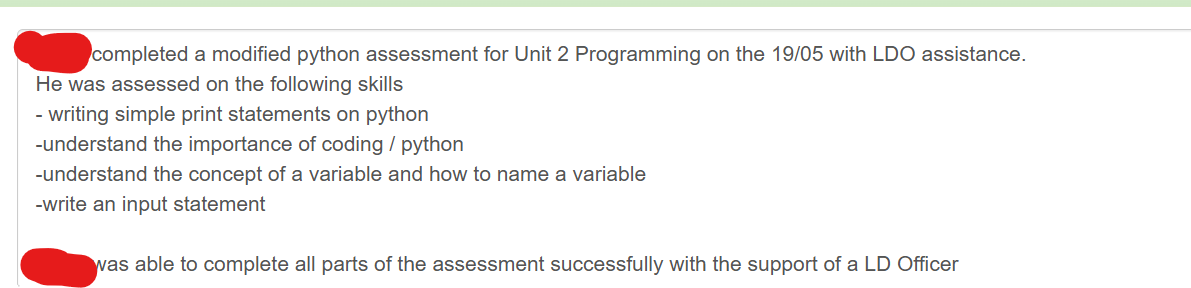
For my student on a Personalised Learning Plan (Student D), who completes modified rather than standardised assessment, I provide individualised written feedback to communicate his learning to his family. Because a standardised mark does not meaningfully capture his progress, I write a personalised paragraph (via Simon, our reporting system) describing what the student was able to demonstrate and achieve within a set timeframe, alongside clear areas for improvement. This ensures that parents receive an accurate, respectful and meaningful account of their child's learning, and that reporting remains fair and appropriate to the individual learner's needs.