1a. The education setting context
Salesian College Chadstone is a Catholic secondary school for boys, catering for approximately 982 students across Years 7 to 12. Located in Chadstone in Melbourne's south-east, the College operates within the Salesian tradition, drawing on the educational principles of its founder, St John Bosco. This charism shapes a school culture centred on relationships, mutual respect, and bringing out the best in each boy, and it underpins the College's commitment to a future-focused pedagogical vision.
The student population reflects a mix of cultural and community backgrounds. The College maintains an English as an Additional Language (EAL) program to support learners for whom English is not a first language, ensuring these students are able to access the curriculum alongside their peers.
Student wellbeing is central to the life of the College, which maintains a formal Child Safety Framework reflecting its position that the care, safety and wellbeing of all young people is a core and fundamental responsibility of the community.
As a Digital Technology teacher within this setting, my practice is situated within these priorities: a boys' learning environment, a commitment to respectful relationships and wellbeing, and a pedagogical culture that values engaging, contemporary and student-centred approaches to learning.
1b. The cohort of learners
This Inquiry is based on my Year 8 Digital Technologies class, an elective subject comprising approximately 25 students. Digital Technologies is a mandatory subject in Year 7 at the College and an optional elective from Year 8 onwards, meaning the boys in this class have actively chosen to continue with the subject.
The class represents a mixed range of learning abilities and needs. Two students have Personalised Learning Plans (PLPs) in place, and a further small group of students have additional learning needs requiring ongoing adjustments to how content is delivered and assessed. At the same time, approximately six students consistently work ahead of the expected level and require genuine extension to remain challenged and engaged. The remainder of the class sit across the middle of this range, presenting a broad and varied group to plan for.
A significant advantage in planning for this cohort was my prior knowledge of the students. Having taught all Year 7 Digital Technologies classes in the previous year — a subject that is mandatory at that level — I had already worked with every boy in this elective before they entered the class. This gave me a well-developed understanding of each student's strengths, areas for growth and learning preferences before the semester began, allowing me to structure my teaching and differentiation with their individual needs in mind from the outset.
1c. The focus learners
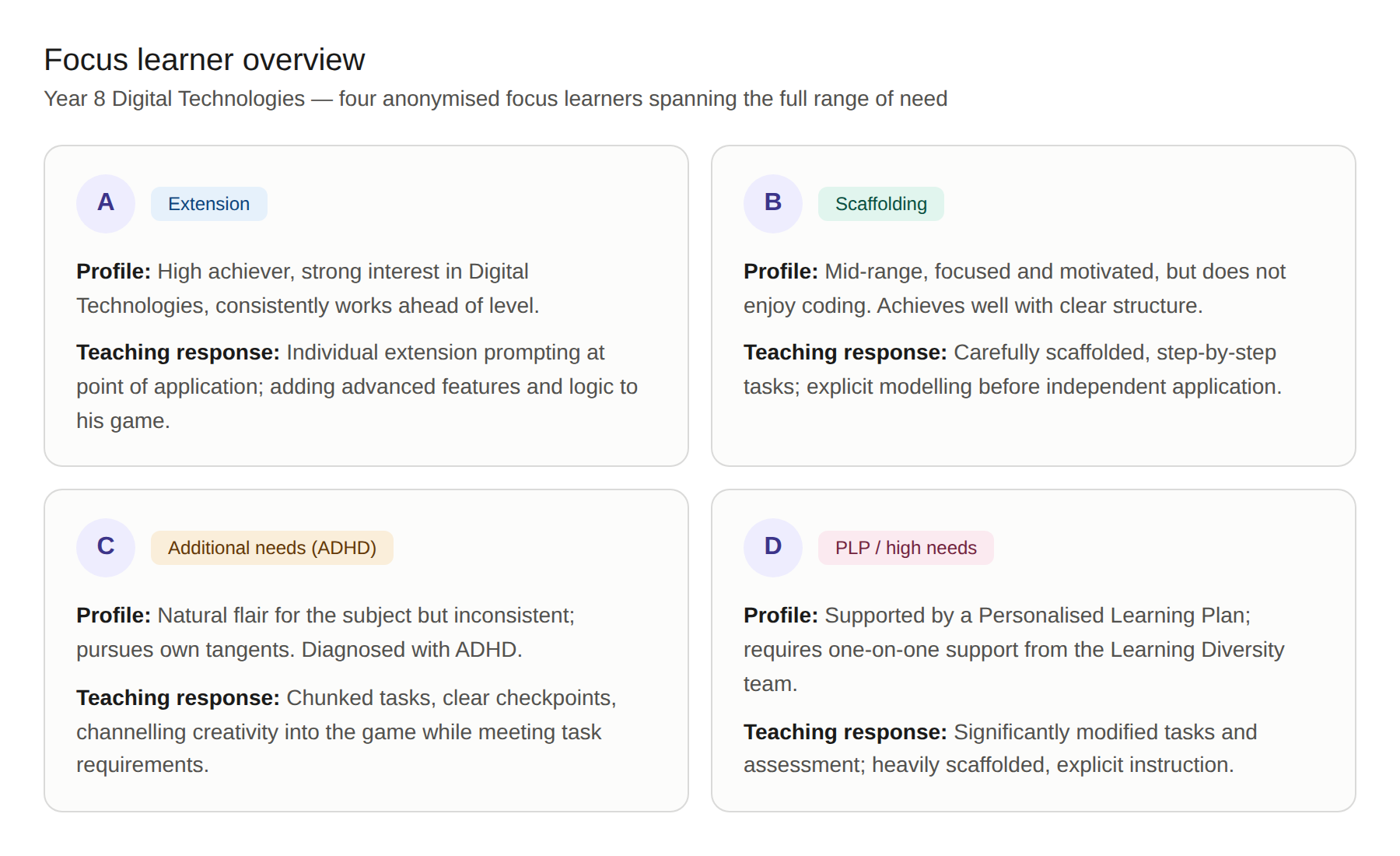
While the Inquiry was designed to benefit the whole class, four focus learners were selected to track the impact of my practice more closely. These four were chosen because they represent the range of learning needs within the class and allow the effectiveness of my differentiation to be examined across the full ability spectrum. To protect their privacy, they are referred to here as Students A, B, C and D.
Student A is a high-achieving learner with a strong personal interest in Digital Technologies. He performed very well in Year 7 and consistently works ahead of the expected level, requiring genuine extension across all units to remain challenged and engaged.
Student B sits in the mid-range of the class. He is focused and highly motivated, but does not enjoy the coding component of Digital Technologies. He has demonstrated that he achieves strong results when tasks are clearly and carefully scaffolded, indicating that his progress is closely linked to the structure and support built into the learning.
Student C has additional learning needs and is diagnosed with ADHD. He has a natural flair for Digital Technologies but finds it difficult to remain consistent with unit materials, often pursuing his own tangents and ideas. The key challenge for this learner is providing opportunities for him to demonstrate his genuine understanding while still meeting the requirements of set tasks.
Student D is supported by a Personalised Learning Plan and has high learning needs. He requires one-on-one attention from members of the College's Learning Diversity team, and his work — including assessment tasks — requires significant modification to allow him to access the curriculum and demonstrate his learning.
The link to my Inquiry question
Each of these learners presents a distinct challenge in ensuring that a single Digital Technologies program can be accessed, and can appropriately challenge, every student in the room. This diversity of need directly shaped the focus of my Inquiry, which sought to develop and refine teaching strategies that would allow all learners — from those requiring significant modification through to those requiring extension — to engage with the content meaningfully and demonstrate genuine understanding.
1d. Program of learning — content
The Year 8 Digital Technologies course is structured around three units, each running for approximately five to six weeks inclusive of assessment: a unit on data and spreadsheets using Microsoft Excel, a unit on programming, and a unit on robotics using LEGO SPIKE. All units are developed in line with the Victorian Curriculum: Digital Technologies.
This Inquiry focuses on Unit 2: Programming. This unit introduces students to text-based programming in Python, building on the block-based coding they encounter in the mandatory Year 7 course and in the robotics work using SPIKE. The transition from block-based to text-based programming is a significant conceptual and emotional step for students at this level. Having worked within the friendly, visual, drag-and-drop environments of block-based coding, many students find the move to Python daunting — particularly their first encounters with syntax errors and the unforgiving nature of a text-based interface.
In my experience teaching this cohort, this apprehension is real and widespread; students frequently express anxiety about programming, often before the unit has even begun. The knowledge and skills I am seeking to develop through this unit include core programming concepts (such as sequence, variables, input and output, selection and iteration), the ability to read and correct errors in code, and computational and problem-solving thinking. Equally important, however, is a shift in disposition — building students' confidence, resilience and willingness to persist when programming becomes challenging, so that they come to experience coding as engaging and achievable rather than intimidating.
1e. Targeted learning outcomes
Through this Inquiry, I sought to achieve outcomes across two connected dimensions: the programming knowledge and skills students would develop, and — central to my Inquiry — a genuine shift in their attitude and confidence towards programming.
Skills and knowledge outcomes
I wanted all students to develop and apply the core programming concepts of the Python unit — including output statements, input, variables, selection (conditionals) and iteration (loops) — and to combine these concepts to build their own working game. I wanted to see this reflected in consistent, sustained classwork, with students actively attempting to learn and apply new skills and drawing on their peers as a resource for their learning.
Attitudinal and engagement outcomes
The most important change I hoped to see was a positive, "have-a-go" attitude towards Python programming across the whole class. Rather than the apprehension students typically bring to the unit, I wanted every learner to engage in some form of learning, to persist through the challenges and errors that programming involves, and to approach coding with a more positive and resilient mindset.
Expected changes in my focus learners
For my extension students, such as Student A, I wanted to see this positive attitude expressed as curiosity and independence — that is, students exploring concepts on their own initiative and coming to me with questions such as, "I've done this, but how can I make it better?". For my mid-range and additional-needs learners, such as Students B and C, success looked like sustained engagement and a willingness to persist with a subject or component (coding) they had previously found difficult or off-putting. For Student D, supported by a Personalised Learning Plan, my goal was that he would complete his modified tasks with a positive attitude and a sense of achievement, able to access and engage with the unit at a level appropriate to him. Across all four, and across the class as a whole, the unifying outcome I was working towards was for students to engage with Python programming positively and with confidence.